

The Decision Break
Support gives way, small caps crack, and markets shift from testing to reacting

Beyond the Noise
March 22, 2026
Market Recap — The Test Failed
Last week, the market was approaching a decision point.
This week, that decision was made.
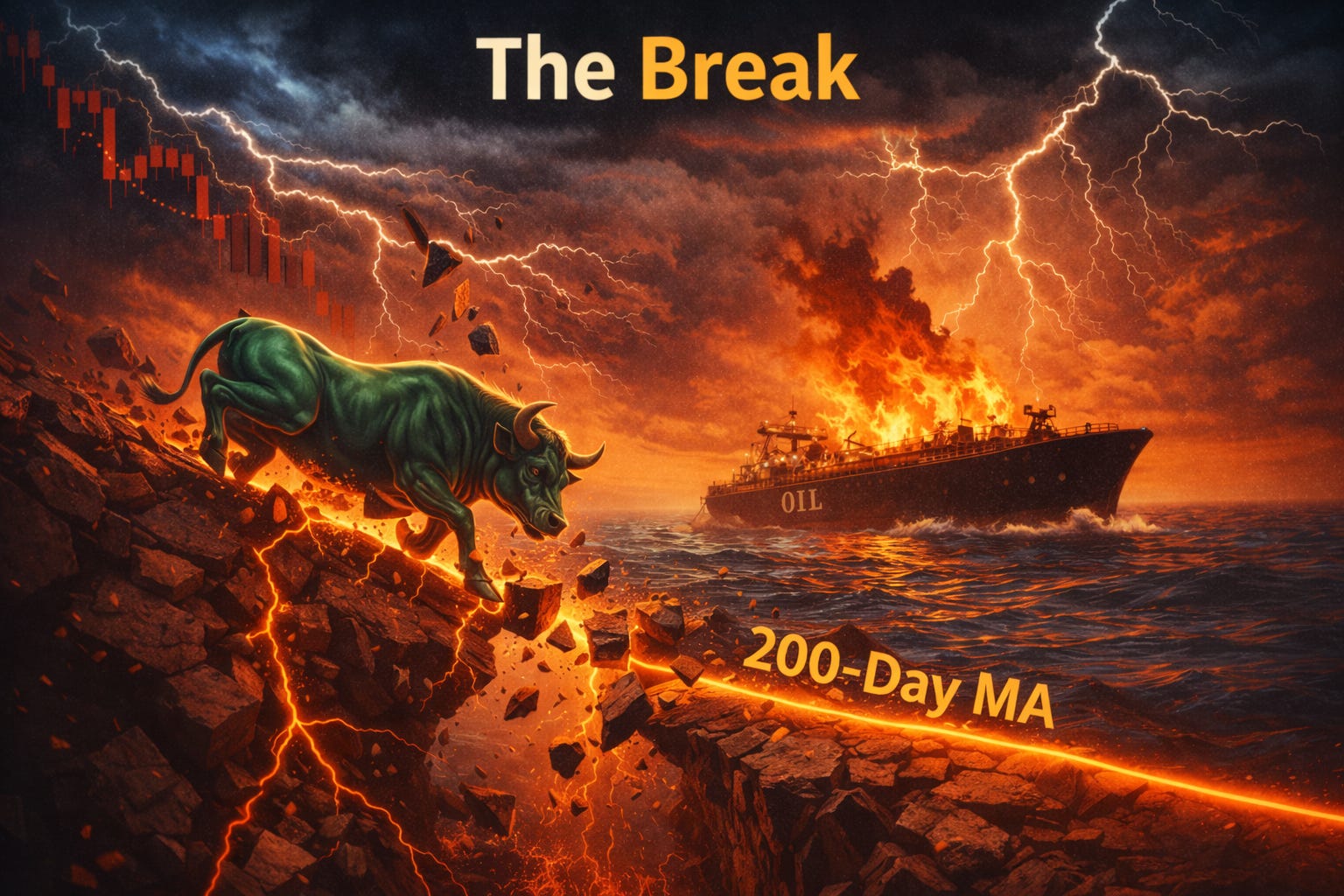
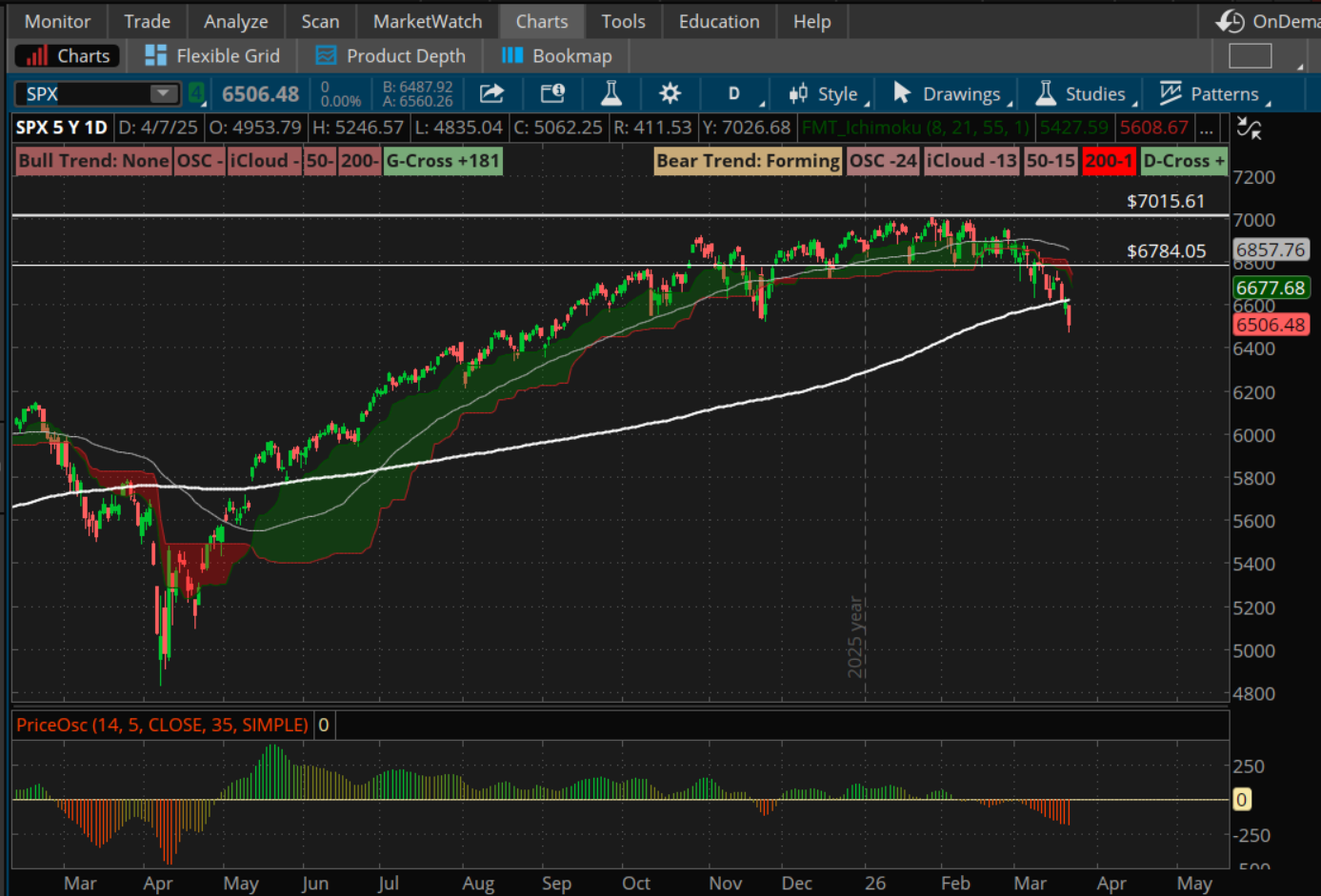
The S&P 500 index broke below its 200-day moving average — a level that had defined the boundary between routine pullbacks and structural weakness for nearly a year.
That matters.
Because once that level gives way, the conversation shifts:
From “Is this a correction?”
To “What kind of correction is this?”
The move was not isolated.
The Russell 2000 index led the decline, officially entering correction territory with a drawdown exceeding 10%.
Small caps tend to lead at turning points — in both directions.
Right now, they’re sending a clear signal:
Risk appetite is deteriorating.
The Macro Story — Pressure Without Resolution
The core macro driver remains unchanged:
Energy and geopolitics.
Oil continued higher this week, reinforcing the market’s concern that supply disruptions — or even the risk of them — could ripple through the global economy.
At the center of that uncertainty is a developing geopolitical flashpoint involving Donald Trump and a looming 48-hour deadline tied to escalating tensions with Iran.
Markets are now in a holding pattern.
Not because nothing is happening…
But because too much hinges on what happens next.
This is a different kind of risk environment:
• Not data-driven
• Not policy-driven
• But event-driven
And event-driven markets tend to move fast once clarity arrives.
Growth Signals — Still Secondary (For Now)
Under normal conditions, this week’s economic calendar would matter.
But this is not a normal week.
The calendar is relatively light, and that matters because it removes a stabilizing force.
There is no steady stream of data to anchor expectations.
Instead, markets are left reacting to headlines.
That said, the underlying backdrop hasn’t improved:
• Growth signals remain mixed
• Labor softness is still being digested
• Manufacturing remains uneven
None of this is catastrophic.
But combined with rising energy costs, it creates a fragile environment.
Technical Context — From Test to Breakdown
Last week we outlined three phases:
Trend
Range
Breakdown attempt
We are now entering Phase Four:
Reaction Phase
• Price is below the 200-day
• Momentum is accelerating lower
• Volatility is expanding
This is where markets become less orderly.
The key shift is this:
The 200-day moving average is no longer support.
It is now possible resistance.
That transition changes positioning behavior across institutions.
Rallies are more likely to be sold.
Bounces are more likely to fail.
Until proven otherwise.
Breadth and Leadership — Weakening Structure
One of the more important developments beneath the surface:
Leadership is narrowing — and in some cases, disappearing.
Small caps are already in correction.
Growth is under pressure.
Defensive positioning is starting to outperform.
This is typical of markets transitioning away from strong uptrends.
It doesn’t mean a full bear market is guaranteed.
But it does mean:
The environment has changed.
Volatility — Expansion Phase
Volatility is no longer a background condition.
It is now part of the story.
As volatility rises:
• Position sizes shrink
• Stops tighten
• Reaction speeds increase
This creates a feedback loop.
Moves extend further than expected.
Reversals happen faster than expected.
And conviction becomes harder to maintain.
The Week Ahead — Headlines Over Data
This week is defined by what’s not on the calendar.
A light economic schedule means:
Breaking news will dominate price action.
The key variable:
How markets respond to the outcome of the current geopolitical deadline window.
This is the type of environment where:
• Overnight risk increases
• Gaps become more common
• Technical levels matter less in the moment
Until the event risk clears.
Big Picture — Regime Shift in Progress
The market environment has clearly changed.
We are no longer in:
• low-volatility trend
• liquidity-supported drift
• predictable pullbacks
We are now in:
• event-driven movement
• higher volatility
• weaker technical structure
This doesn’t guarantee a prolonged downturn.
But it does mean:
The playbook needs to adjust.
Trader’s Playbook
• Respect the break below the 200-day
• Treat rallies as suspect until structure improves
• Watch small caps for confirmation or divergence
• Monitor oil as the primary macro pressure gauge
• Expect headline-driven volatility
• Reduce size and increase selectivity
Closing Thought
Last week, the market was approaching a test.
This week, it failed that test.
Now the question is no longer whether support will hold…
But whether the market can stabilize after losing it.
That answer will likely come not from charts…
But from headlines.